

White-Label Payments for ISVs
By Dale Erling 15+ years in payments and fintech | Last updated: March 2026 | Time to read: ~8 minutes
A white-label payment gateway is a fully branded payment processing platform built on a third-party infrastructure, allowing businesses, banks, or ISVs to offer payment services under their own name without building proprietary technology. IntelliPay’s white-label program provides a PCI DSS Level 1-certified gateway, multi-channel payment support, and Google Cloud scalability — giving partners enterprise-grade infrastructure with complete brand control. Financial institutions can use white-label gateways to generate non-interest income from merchant processing without the capital cost of building a proprietary network.
What Is a White-Label Payment Gateway for ISVs?
A white-label payment gateway is a fully operational payment processing platform that an ISV licenses and deploys under its own brand. Rather than building payment infrastructure from scratch — which requires years of development, significant capital investment, and ongoing PCI certification- your team integrates a proven backend and presents it as a native feature of your software.
Not all white-label gateways are built the same. The critical differentiators are where cardholder data lives, who is responsible for securing it, and how deeply the solution integrates into your existing architecture.
Why ISVs Choose IntelliPay Over Commodity Gateways
IntelliPay was built for businesses that need flexible, deeply integrated payment acceptance — not a bolted-on processor designed for high-volume ISOs or global enterprise merchants. IntelliPay specializes in mid-market ISVs serving government, utilities, healthcare, and small businesses across the United States, with purpose-built tools for the verticals that demand the most from a payment partner.
What Sets IntelliPay apart:
Vertical-specific expertise: Designed for utilities, municipalities, charter schools, and healthcare billing sectors with unique compliance requirements, fee structures, and customer expectations
Fee pass-through models: Dual pricing, surcharging, and service fee programs allow ISVs to offer zero-net-cost processing to their merchant customers, compliantly
Full branding control: Your logo, your domain, your customer portal — IntelliPay’s infrastructure remains completely invisible to your end users
Transparent pricing: Interchange-plus pricing with no hidden fees, no junk charges, and no surprises on your merchants’ statements
Bilingual IVR: Pay-by-phone with bilingual automated scripts expands accessibility and reduces agent load for your customers
Payment Acceptance Capabilities
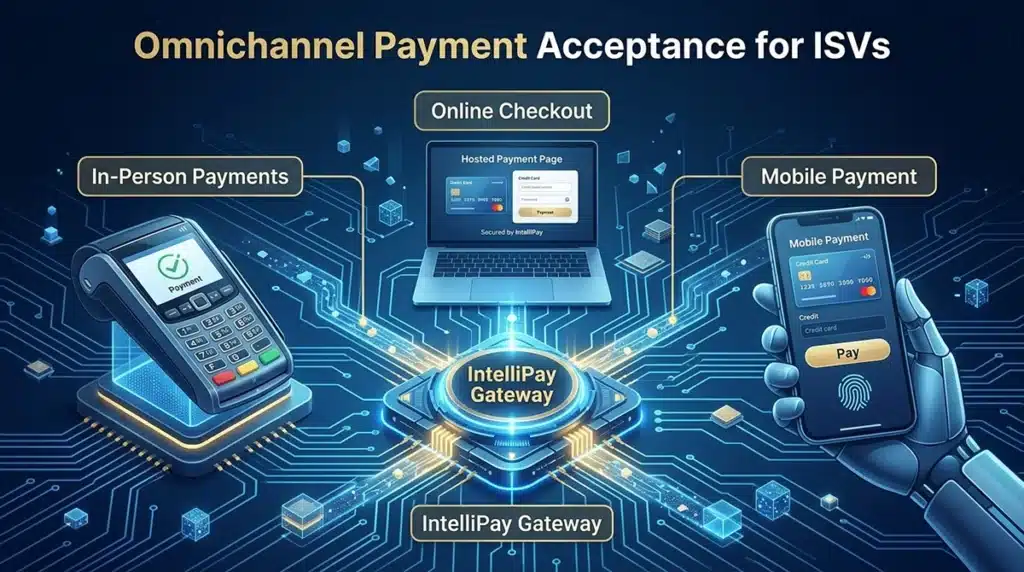
IntelliPay supports the full spectrum of payment channels, enabling a single integration that serves your customers across every touchpoint.
Hosted Payment Pages: Fully branded, PCI-compliant pages hosted entirely on IntelliPay’s certified network — card data never touches your servers
Lightbox Payment Overlays: Customizable payment forms that float over your existing UI, maintaining a seamless user experience without redirecting customers away from your platform
In-Person / EMV: Verifone, Dejavoo, and IDTECH terminal integrations with full EMV chip, contactless, and swipe support.
IVR / Pay by Phone: Bilingual automated phone payment systems that reduce agent burden and late payments
Recurring Billing: Automated payment scheduling for subscription and installment-based billing models
ACH / eCheck: Bank transfer options that reduce interchange costs and serve customers who prefer or require non-card payment methods
Fee Management: Embedded Cost-Shifting for Your Merchants
One of IntelliPay’s most powerful differentiators is the ability to embed compliant, cost-shifting payment models directly into your software — models that can reduce or eliminate net processing costs for your merchant customers entirely.
Dual Pricing / Consumer Choice: Displays two prices at checkout — one for card, one for cash or ACH — giving the customer the choice while keeping your merchant customers fully compliant with card brand rules
Surcharging: Automatically calculates and adds a compliant surcharge to credit card transactions, offsetting processing costs without manual intervention
Service Fee / Convenience Fee Programs: Designed specifically for government and utility ISVs collecting non-recurring payments, keeping fee structures compliant under Visa and Mastercard program guidelines
Compliance Liability Transfer: The Hidden Value Proposition
What many white-label providers overlook is where the weight of PCI compliance actually lands. In a typical gateway model, the deploying organization must independently certify and maintain its own Cardholder Data Environment (CDE) — inheriting heavy audit burdens, staff training requirements, infrastructure security mandates, and direct legal exposure every time a card transaction flows through the system. For a software company whose core competency is not payments, this overhead is costly, distracting, and entirely avoidable.
How Traditional Payment Integration Creates Compliance Risk
Most payment integrations route transaction data through the ISV’s application layer before passing it to a processor. This seemingly minor architectural decision has significant consequences:
The ISV’s systems enter the scope of PCI DSS, requiring annual validation
Development teams must maintain PCI-specific secure coding standards across every release
Internal staff must complete mandatory PCI security training annually
A single misconfiguration can trigger breach notification obligations and card brand fines
A full Report on Compliance (RoC), conducted by a Qualified Security Assessor (QSA), can cost $50,000–$200,000 and take months to complete
This is the hidden cost that most gateway vendors bury in the fine print.
How IntelliPay’s Architecture Reduces PCI Scope
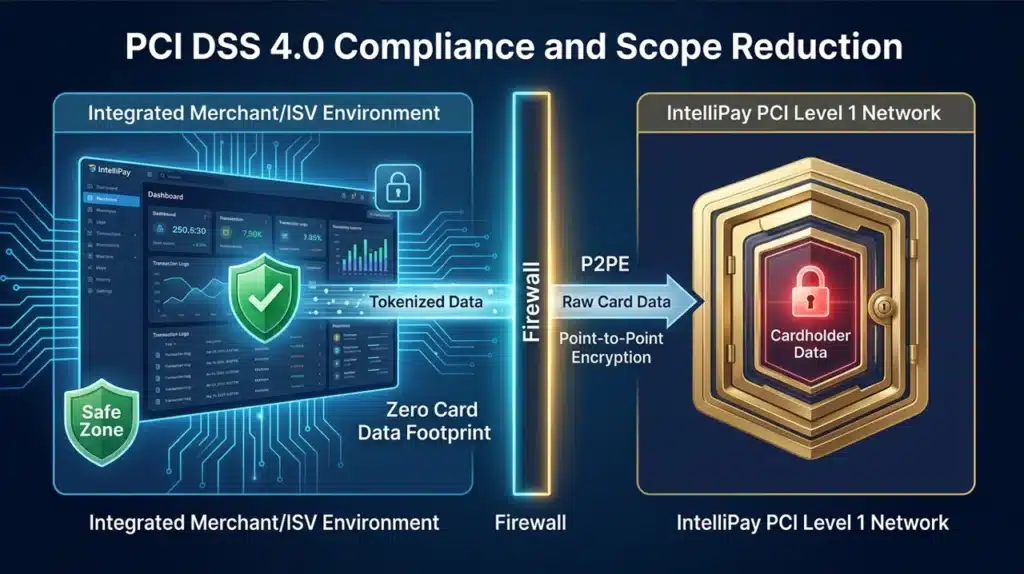
IntelliPay’s architecture is built around a fundamentally different model. By routing all transactions through its PCI DSS 4.0 Level 1–certified network — the industry’s most current and rigorous security standard — the platform ensures raw cardholder data never enters the ISV’s environment.
Point-to-Point Encryption (P2PE) secures card data from the moment it is captured. Tokenization replaces sensitive card numbers with a non-sensitive token before any data moves through the integration. Combined with hosted and Lightbox payment flows that collect sensitive inputs entirely on IntelliPay’s network, your application never touches, transmits, or stores raw cardholder data.
Compliance Impact: Traditional vs. IntelliPay
| Compliance Scenario | Traditional Integration | IntelliPay White-Label |
|---|---|---|
| PCI Standard | Full CDE scope | Reduced scope |
| Audit Type | Full Report on Compliance (RoC) | Simplified SAQ A in most cases |
| Estimated Annual Cost | $50,000–$200,000+ | Minimal internal self-assessment |
| QSA Engagement | Required annually | Typically not required |
| Dev Burden | Secure coding review on every release | Standard development practices |
| Staff Training | Mandatory PCI-specific training | General security awareness is sufficient |
| Breach Exposure | Direct liability for card data in your system | Data is never in your environment |
PCI DSS 4.0: What Changed and Why It Matters to ISVs
As of March 31, 2025, PCI DSS 4.0 became fully mandatory, and the new standard raises the bar significantly for any organization whose systems touch cardholder data. Key changes directly affecting ISVs include:
Requirement 6.4.3: All payment page scripts must be authorized, have an assigned business justification, and be integrity-checked
Requirement 11.3.2: External-facing web applications must be reviewed or tested for vulnerabilities at least once every 12 months
Enhanced MFA: Multi-factor authentication is now required for all access to the CDE, with fewer exceptions than prior versions
Continuous Monitoring: Annual point-in-time assessments are no longer sufficient — ongoing control verification is now expected
Because IntelliPay’s hosted payment architecture keeps ISV environments outside the primary CDE scope, partners are largely shielded from these new requirements. IntelliPay’s infrastructure absorbs the compliance obligations, so your team doesn’t have to
The Business Case: What Scope Reduction Means for Your Software Company
The compliance benefits IntelliPay provides are not just technical — they are a structural business advantage that compounds over time.
Faster go-to-market: No need to build or certify your own payment infrastructure before launching
Reduced operating costs: Annual compliance overhead drops from six-figure audit cycles to an internal self-assessment
Cleaner software architecture: Your codebase is never responsible for protecting cardholder data
Stronger sales positioning: You can truthfully tell prospects your platform does not store or transmit card data
Lower cyber liability insurance premiums: Insurers heavily weigh whether an organization handles raw card data when calculating risk
Retained engineering focus: Your developers build product features — not payment security controls
Frequently Asked Questions for ISV Partners
Does IntelliPay eliminate my PCI compliance requirements?
No provider can eliminate your compliance obligations entirely — PCI DSS applies to any organization involved in payment card processing. However, IntelliPay’s architecture ensures card data never touches your environment, which typically qualifies your organization for a simplified SAQ A rather than a full RoC, dramatically reducing your annual compliance workload and cost.
What is the difference between SAQ A and a full RoC?
A Self-Assessment Questionnaire A (SAQ A) is a simplified, self-completed validation for organizations that have fully outsourced card data handling to a PCI-compliant provider. A Report on Compliance (RoC) is a full, QSA-conducted audit required when an organization’s systems directly touch cardholder data. The cost difference between the two can exceed $150,000 annually.
How does IntelliPay support the new PCI DSS 4.0 requirements?
IntelliPay’s infrastructure is fully updated to meet the mandatory 2026 standards under PCI DSS 4.0, including enhanced Multi-Factor Authentication (MFA), continuous monitoring of payment scripts, and script integrity controls on all hosted payment pages. Your integration remains compliant with the latest global security mandates without requiring changes to your core software architecture.
Is IntelliPay’s Level 1 certification independently verified?
Yes. IntelliPay is a PCI DSS Level 1–certified service provider, audited annually by a Qualified Security Assessor (QSA). An Attestation of Compliance (AoC) is available upon request for partners conducting vendor due diligence.
How long does it take to integrate IntelliPay into an existing ISV platform?
IntelliPay provides documented API and DLL integration paths, along with hosted and Lightbox options that can be embedded with minimal development lift. The right path depends on your software architecture and the payment channels you need to support.
Can my end customers use their own branding?
Yes. IntelliPay’s white-label model gives your merchant customers a fully branded portal and payment experience – your logo, your domain, your interface. IntelliPay remains behind the scenes at every level.
Q: What is a white-label payment gateway?
A: A white-label payment gateway is a payment processing platform that one company builds and another company licenses, customizes with its own branding, and offers to its customers as its own product. The end customers — merchants or payers — interact entirely with the licensee’s brand; the underlying technology and compliance infrastructure is provided by the gateway vendor (in this case, IntelliPay).
Q: What is the difference between a white-label gateway and becoming a PayFac?
A: A Payment Facilitator (PayFac) takes on direct liability for sub-merchant underwriting and settlement, requiring significant capital reserves and regulatory registration. A white-label gateway partner uses an established processor’s merchant account infrastructure, avoiding that liability while still offering branded payment services. White-label is generally the faster, lower-risk path for banks, ISVs, and software platforms entering the payments market.
Ready to explore what IntelliPay’s white-label platform can do for your software? Contact our integration team to discuss your use case and request an Attestation of Compliance.
The information provided here is for informational purposes only and does not constitute legal, financial, or compliance advice. PCI DSS standards and card brand rules are subject to change. Businesses should consult qualified legal counsel or a Qualified Security Assessor (QSA) to ensure their specific implementation meets all applicable current requirements.
