

Contents
- Executive Summary
- Dual Pricing vs. Surcharging: The Strategic Difference
- What is Surcharging?
- What is Dual Pricing?
- Pros and Cons of Dual Pricing in Retail
- Impact on Customer Loyalty and Perception
- Customer Loyalty in E-commerce
- The Psychology of Customer Perception
- Best Practices for Communication
- Advanced Applications: Subscriptions and Ethics
- Can dual pricing be effective for subscription services?
- Ethical Concerns: Domestic vs. International Pricing
- Common Surcharging Mistakes and Risks
- FAQs:
- Legal Disclaimer
Executive Summary
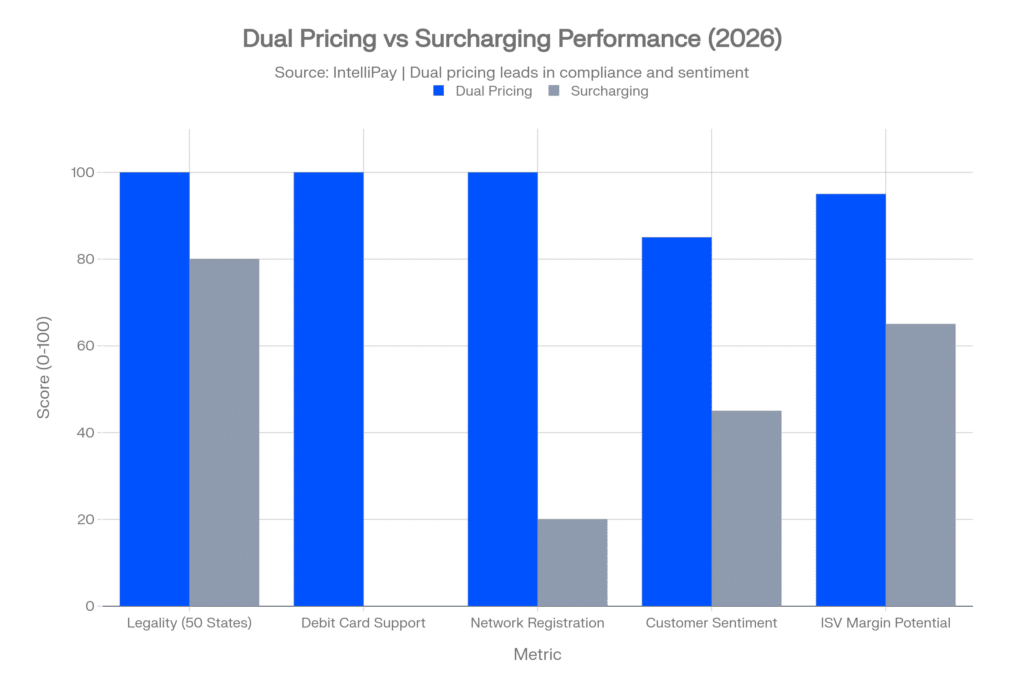
For modern ISVs and financial institutions, the “cost” of payments is no longer a fixed overhead—it is a strategic variable. Navigating the shift between Dual Pricing and Surcharging requires more than just a compliance checklist; it requires an understanding of consumer behavior and platform monetization. While surcharging passes credit card costs directly to the buyer, Dual Pricing (Consumer Choice) has emerged as the superior model for 2026 due to its universal legality and positive psychological framing. This article explores how to implement these models to protect margins, maintain customer loyalty, and avoid the common pitfalls of fee-based pricing.
Dual Pricing vs. Surcharging: The Strategic Difference
While often used interchangeably, Dual Pricing and Surcharging are fundamentally different in the eyes of regulators and consumers.
What is Surcharging?
Surcharging adds a fee at the point of sale to credit card transactions. It is restricted by state law (prohibited in CT, ME, MA, etc.) and requires registration with the payment processor. Learn more about the differences between surcharging and dual pricing here.
What is Dual Pricing?
Dual Pricing displays two separate prices: a standard “Card Price” and a discounted “Cash/ACH Price”. Read more here.
Pros and Cons of Dual Pricing in Retail
Pros: It is legal in all 50 states, requires no network registration, and applies to both credit and debit cards. It also feels like a “reward” for cash users rather than a “penalty” for card users.
Cons: It can cause confusion if not communicated clearly at the shelf level, and businesses must ensure their POS hardware can display both prices simultaneously to stay compliant.
Impact on Customer Loyalty and Perception
One of the primary concerns for e-commerce and retail brands is how these models affect long-term customer relationships.
Customer Loyalty in E-commerce
In the digital space, “surprise” fees at the final checkout screen are a leading cause of cart abandonment. Dual pricing models that show the discount early in the funnel tend to maintain higher loyalty than surcharging models that add a 3% fee only after the customer has entered their card info.
The Psychology of Customer Perception
Surcharges often trigger “loss aversion”—a psychological pain associated with losing money. Conversely, Dual Pricing frames the lower price as a gain, which is statistically less likely to result in customer backlash or a move toward competitors.
Best Practices for Communication
To avoid backlash, businesses should use clear signage that emphasizes choice. Instead of “3% fee for cards,” use “Save 3% by paying with Cash or ACH”.
Advanced Applications: Subscriptions and Ethics
Can dual pricing be effective for subscription services?
Yes. For SaaS and recurring billing, offering a “standard” rate for card payments and a “discounted” rate for annual ACH/EFT payments is a highly effective way to reduce churn and processing costs.
Ethical Concerns: Domestic vs. International Pricing
Different pricing for international customers often stems from the higher interchange costs associated with cross-border transactions, often 1-2% higher. While ethical, the best practice is transparency: if a higher rate is applied to an international card, it should be disclosed as a “Cross-Border Transaction Fee” rather than a hidden markup .
Common Surcharging Mistakes and Risks
Many businesses fail to implement convenience fees or surcharges correctly, leading to audits and fines.
Mistake 1: Surcharging Debit Cards. This violates the Durbin Amendment and can lead to the immediate termination of a merchant account.
Mistake 2: Profit-Taking on Fees. Surcharges cannot exceed the merchant’s actual cost of acceptance (capped at 4% but usually limited to ~3% by most networks).
Mistake 3: Network Discrepancies. Risking backlash by charging different rates for Visa versus American Express. Most best-practice implementations use a flat “Credit Card Fee” that averages the costs across all networks to avoid customer confusion.
FAQs:
How do popular payment processors handle surcharging fees?
Most “flat-rate” processors do not support compliant surcharging out of the box. IntelliPay’s gateway is unique because it automates the detection of card types (Credit vs. Debit) and applies the correct fee or discount in real-time based on the merchant’s specific configuration.
Is surcharging allowed on online transactions?
Yes, major payment services allow online surcharging, provided the merchant follows the same disclosure and registration rules as in-store businesses (30-day notice to networks, clear checkout disclosure).
Which companies successfully use dual pricing to increase profits?
Utility companies and government municipalities were early adopters. Today, high-margin service businesses (HVAC, Legal, Dental) use it to offer a lower “Cash/ACH” price while protecting their margins on large-ticket transactions.
Legal Disclaimer
This article is for informational purposes and does not constitute legal advice. Compliance requirements for Dual Pricing and Surcharging vary by state and card network rules. Always consult with a legal professional before implementing new fee structures.