
Reduce or Eliminate Card Fees
Flexible options, clear pricing—shift costs or save, the choice is yours.
Quick Overview: Payment Options & Merchant Benefits
Dual Pricing:
Shows both cash and credit prices, empowering customer choice and reducing merchant costs.Surcharging:
Enables merchants to pass credit card fees to customers where legal, increasing savings.Convenience Fee:
Fixed fees for specific channels, designed for government, education, and utilities.Service Fee:
Compliant models that separate processing fees for regulated and public entities.Absorb Fee Model:
Traditional approach—merchant pays all processing fees for customer simplicity.- ACH & E-Check:
Low-cost, secure options that minimize processing expenses and support large or recurring payments.
- Apple Pay, Google Pay & Digital Wallets:
Accepts payments via Apple Pay, Google Pay, PayPal, and other digital wallets online or in person—fast, secure, and user-friendly for today’s consumers. - Contactless Payments:
Supports NFC and tap-to-pay, allowing safe, rapid in-person transactions with mobile devices and cards. - Omni-Channel Flexibility:
Unified reporting for in-person, online, mobile, and recurring payments—all in one platform. - PCI & Regulatory Compliance:
End-to-end security for every model, exceeding PCI DSS Level 1 standards and supporting complex compliance needs. - Custom Integration:
APIs, prebuilt plugins, and expert support for seamless deployments to any business or government environment.
IntelliPay Saves You Money
Eliminate unpredictable card processing costs and protect your margins with IntelliPay. Our flexible solutions—including dual pricing, surcharging, convenience fees, and traditional pay-all-fees programs—put you in control. You’ll benefit from transparent interchange-plus pricing, zero hidden fees, a wide range of payment options including digital wallets, superior reporting, and features customized for your business. Discover the right payment model to optimize your processing costs today.
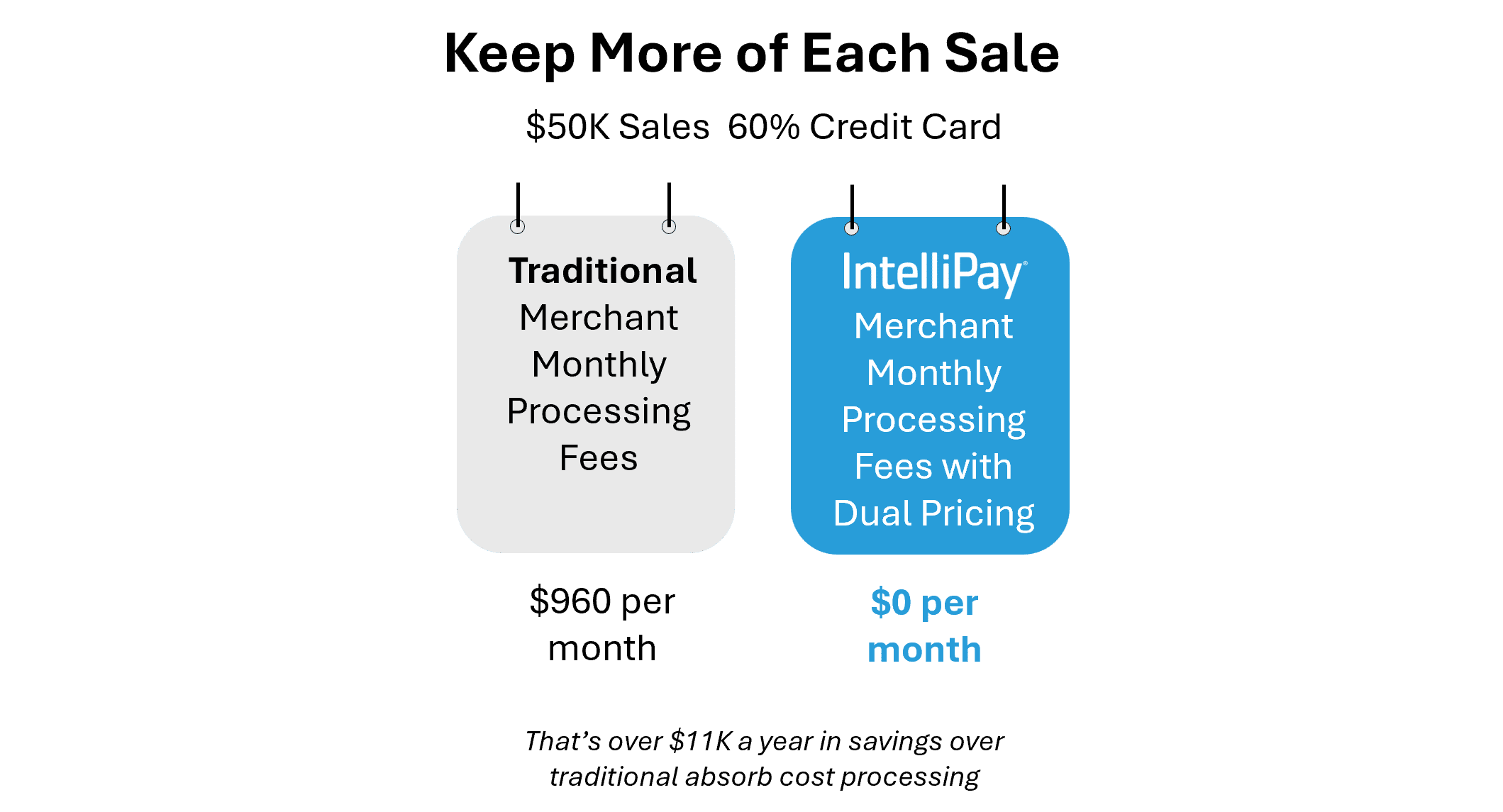
Merchant Savings with IntelliPay Compared to Traditional Processing
Ever wonder how much card processing actually costs—and if you’re paying junk fees? With IntelliPay, you can use dual pricing, surcharging, or a convenience fee to shift card costs to customers.
Don’t want to shift processing costs to customers? You save too! With IntelliPay, you get true transparency and no hidden charges. We use real interchange plus pricing, so you always know exactly what you’re paying and why.
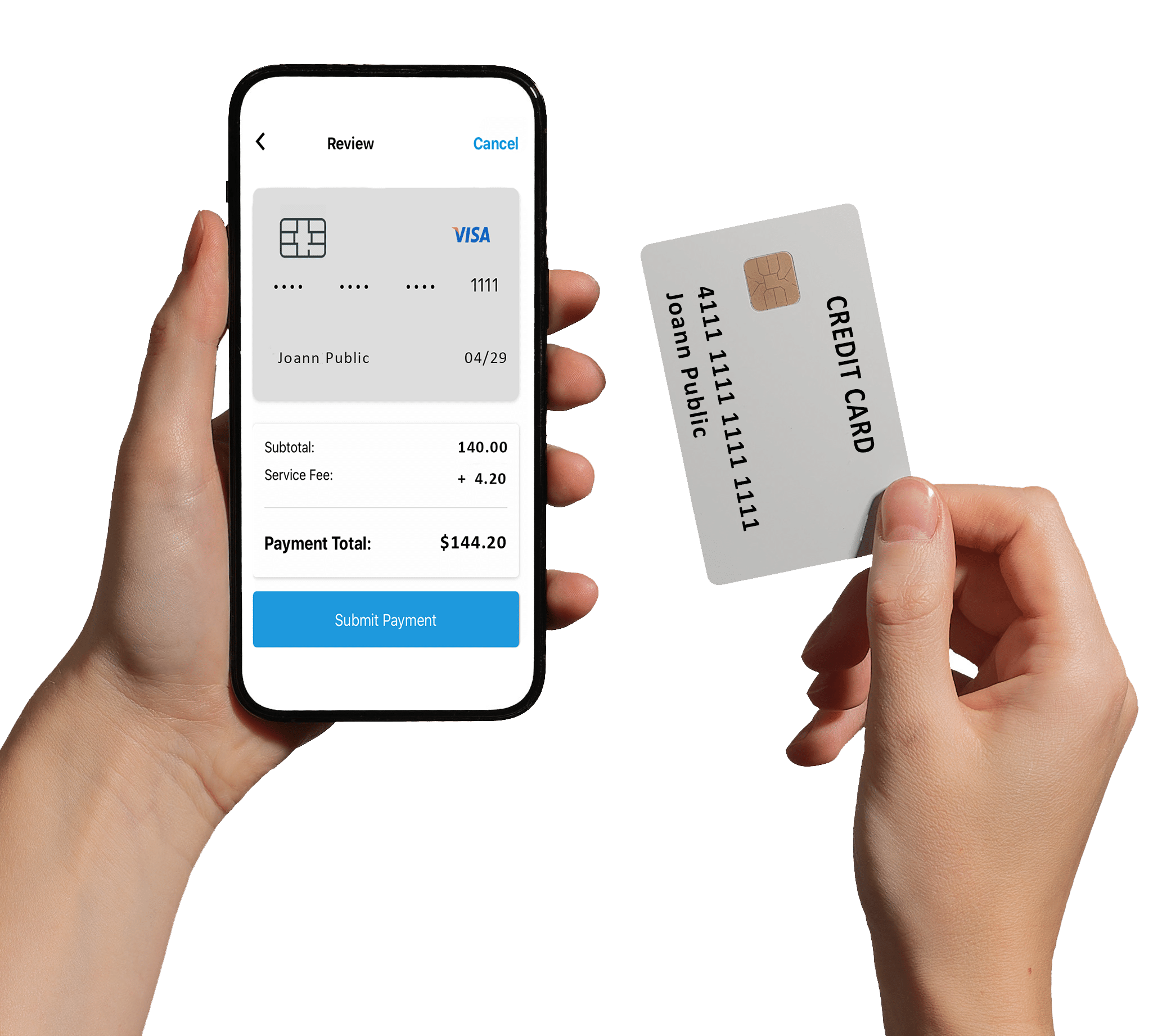
DUAL PRICING
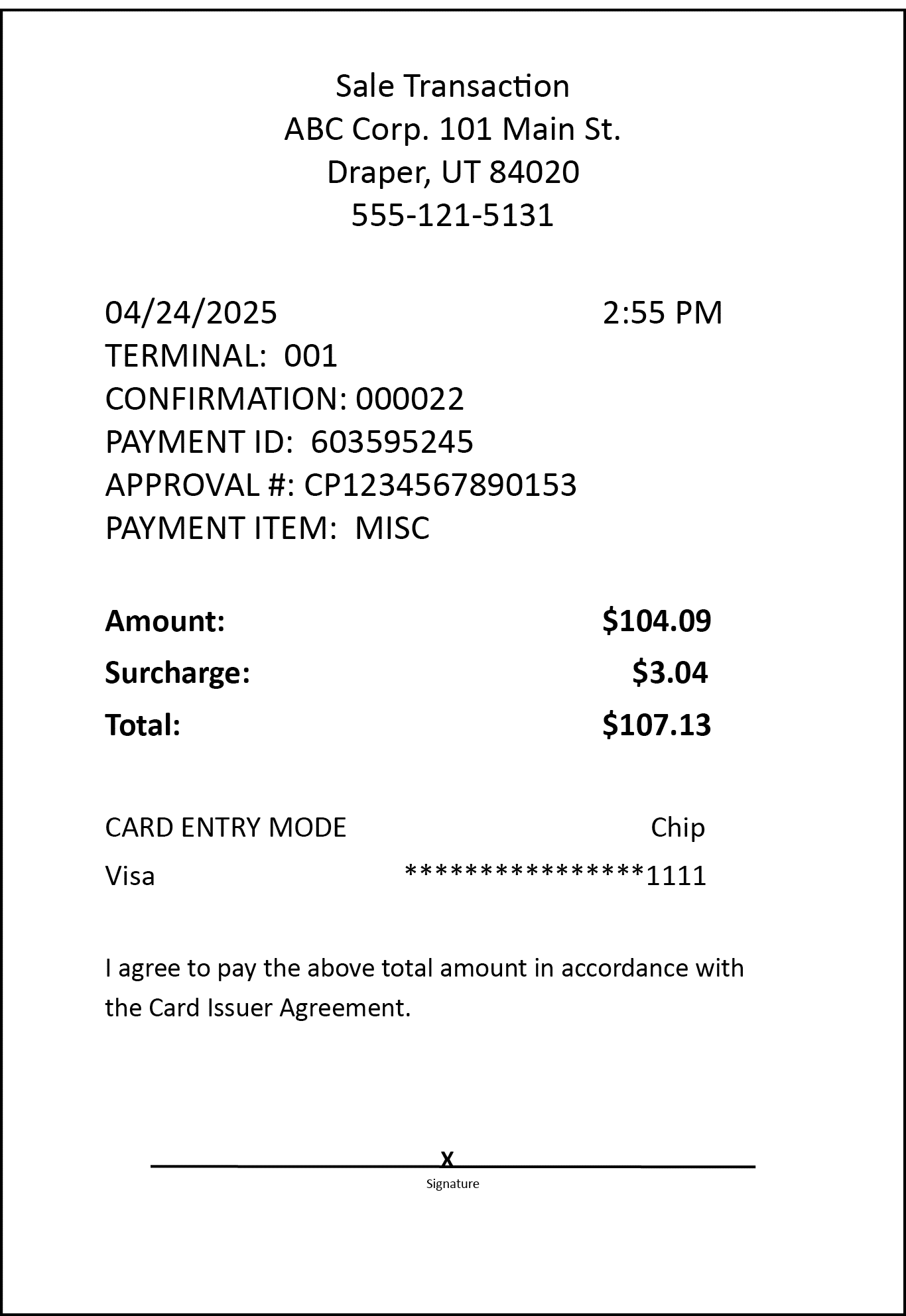
SURCHARGING
CONVENIENCE FEE
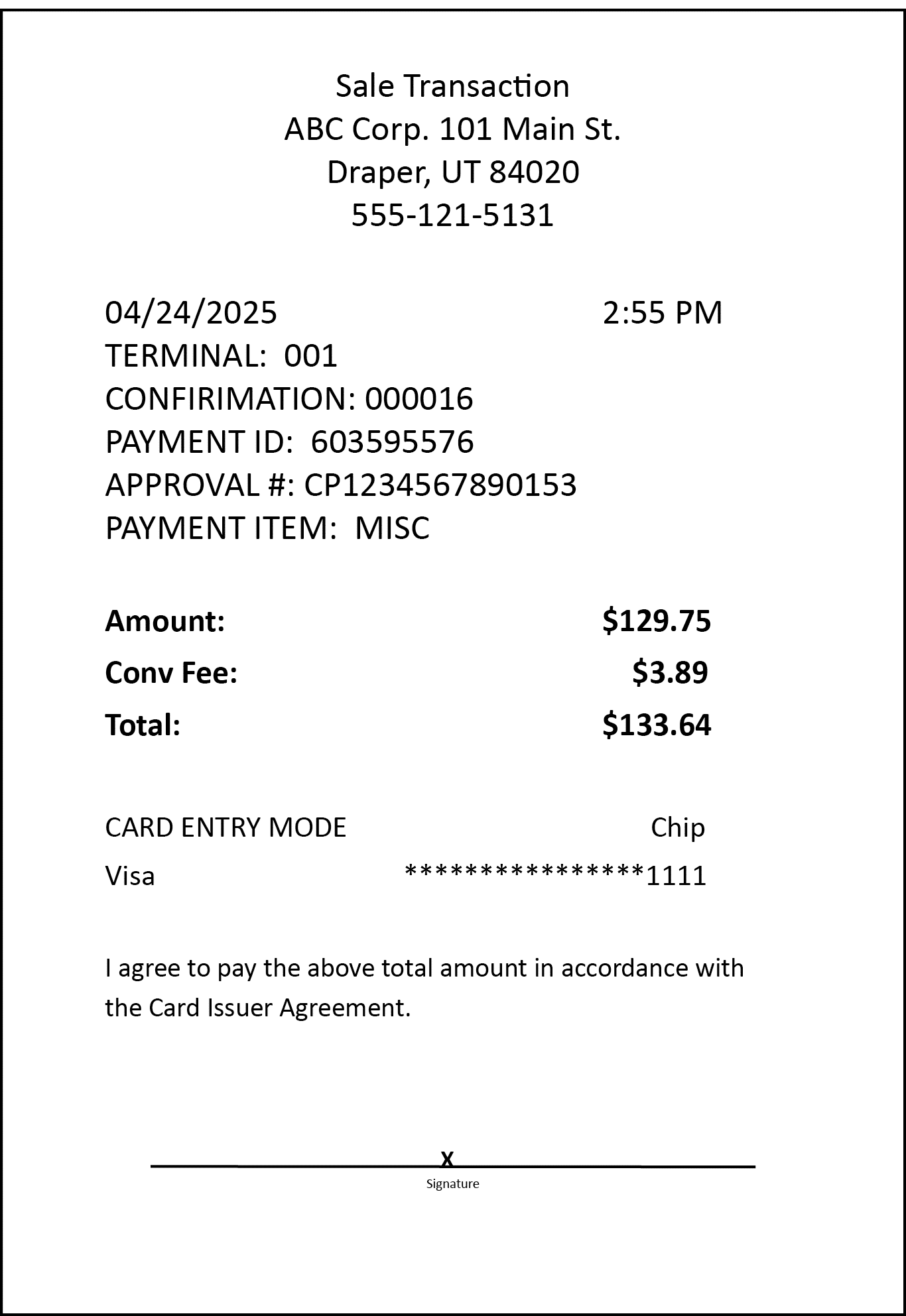
SERVICE FEE

See our complete Service Fee FAQs here
Single Dip, Two Deposit Technology U.S. Patents 11,429,952, or 12,373,819
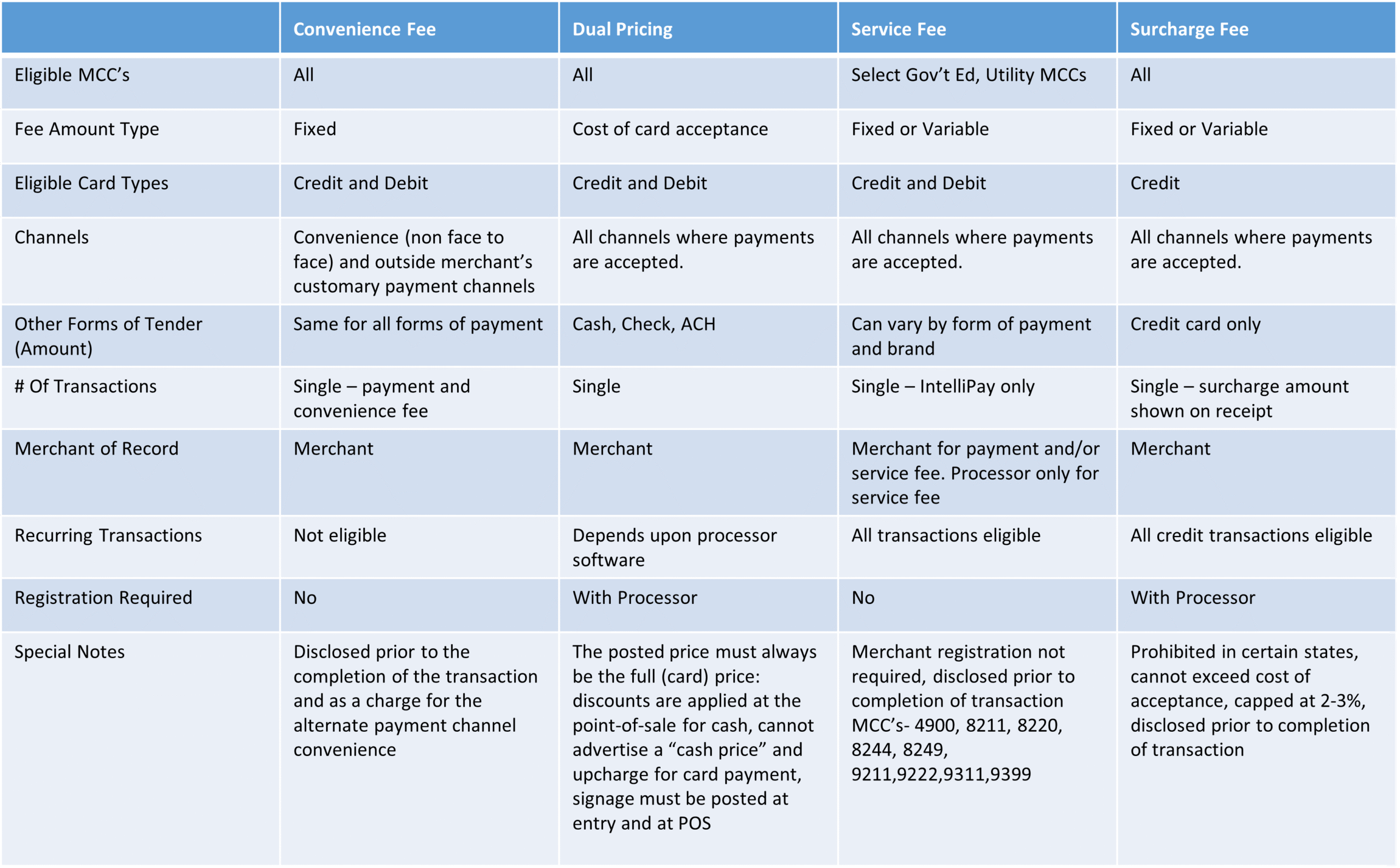
The Right Solution for My Business
Choosing a payment program shouldn’t be hard. Compare your options in this chart. Still have questions? Check out the links below or talk to with us. There’s no-obligation, and we’re here to help you find the best fit for your organization, every time.
Discover more here:
How to Lower Credit Processing Fees and Improve Margins
Passing Credit Card Fees Onto Customers
Choose the Right Provider
Since 2011, IntelliPay has been the trusted payment partner for thousands of organizations nationwide, across public and private sectors. We hold PCI DSS Level 1 certification—the highest standard for secure payment processing—and handle billions of dollars in payments annually. Choose IntelliPay for:
Comprehensive payment options including credit, debit, Apple Pay, digital wallets, and ACH/eCheck
Robust security and advanced fraud prevention technologies
Over 70 years of combined payments industry experience among our team
Transparent, straightforward pricing with no hidden fees
Seamless integration and dedicated customer support
With IntelliPay, you get a trusted, compliant, and innovative partner dedicated to optimizing your payment processing and reducing costs.
Payment Models FAQs
Q. Is Dual Pricing and Cash Discounting the same thing?
A.
- Dual Pricing and Cash Discounting are related but not the same thing. Both help merchants offset credit card processing fees and encourage customers to pay with cash, but they operate differently and have distinct compliance requirements.
Key differences:
- Dual pricing presents two prices at the point of sale—one for cash, one for card—so customers can easily see the cost difference and choose their preferred payment method.
- Cash discounting posts a single price (usually the card price) and then subtracts a discount if the customer pays with cash.
Dual pricing differentiates prices based on payment methods, while a cash discount reduces the price for those who pay with cash. … Dual Pricing allows customers to choose their payment method freely, offering savings on processing fees when paying with cash. In contrast, Cash Discount pricing directly incentivizes cash payments by lowering the list price.
Q. What is the difference between dual pricing and surcharging?
A. Dual pricing is a transparent, compliant way to present two payment options, while surcharging adds a fee to card transactions after the fact and is more tightly regulated.
- Dual pricing is about offering a choice: the customer picks cash or card, each with its own clearly posted price. It is transparent and generally well-received, as it feels like a reward for cash payments.
- Surcharging adds a fee to the end of the transaction only if the customer chooses to pay by credit card, making the fee a surprise and the card payment more expensive than the posted price. This is often perceived as a surprise fee and is subject to more legal restrictions and disclosure requirements
Q. Is this the same as the "convenience fee" we've heard about for government?
A. Visa Service Fees are more flexible in structure (can be percentage-based) but more restricted in who can use them (only government/education), while Convenience Fees are more widely available but must follow stricter rules about being flat fees and apply equally to all payment methods.
- Service Fee: For certain government/education MIDs, can be percentage or flat, processed by TPP, no alternative payment required.
- Convenience Fee: For any merchant, must be flat, processed by merchant, must offer a no-fee alternative payment method.
Q. How does IntelliPay help businesses save money on payment processing?
A. IntelliPay helps businesses save money on payment processing use fee-based payment models.
We offer options like dual pricing, surcharging, service fees, and convenience fees that allow businesses to pass some or all credit card processing costs to customers. This means merchants can reduce or even eliminate the fees they would otherwise pay, especially on high-cost rewards cards.
Q, Is surcharging legal in my state?
A. As of July 2025, credit card surcharging is legal in most U.S. states and territories, but there are important exceptions and limitations. Here’s a detailed breakdown based on the latest available information:
States Where Credit Card Surcharging Is PROHIBITED:
- Connecticut
- Maine
- Massachusetts
- California (effective July 1, 2024)
Special Cases and Restrictions
Colorado: Surcharging allowed but capped at 2%.
New York, New Jersey, Nevada, South Dakota: Surcharges cannot exceed the actual cost the merchant pays to accept the card.
Minnesota: Surcharging is legal, but as of January 1, 2025, mandatory fees must be included in the advertised price unless avoidable by the consumer.
Q. What do I need to do to get started with Dual Pricing?
A.To get started with Dual Pricing please read our The Complete Guide to Dual Pricing or contact an IntelliPay expert for help.
Q. What is a convenience fee?
A. A convenience fee is a small, flat fee that a business charges when a customer chooses to pay using a method that’s not the business’ standard way of accepting payments. For example, if a business usually takes payments in person, but have customer who want to pay online or over the phone, they might add a convenience fee for the “convenience” of using that alternative channel.
So, in short, a convenience fee is what you pay for the flexibility of choosing a different way to pay, and it helps businesses cover some of the costs that come with offering those extra payment option.
Q. What government entities and Higher Education Institutions can charge service fees?
A. O only specific government entities and higher education institutions with certain Merchant Category Codes (MCCs)
Eligible Government Entities, those processing payments under these MCCs:
MCC 9311: Tax payments
MCC 9222: Fines
MCC 9211: Court costs
MCC 9399: Miscellaneous government services
Eligible Higher Education Institutions, those processing payments under these MCCs:
MCC 8211: Elementary/Secondary Schools
MCC 8220: Colleges, Universities, Professional Schools, Junior Colleges
MCC 8244: Business Schools
MCC 8249: Trade Schools
Q. How does the convenience fee model work?
A. With IntelliPay’s convenience fee model, a merchant charges a flat fee for the privilege of paying for a product or service using an alternative payment channel or a payment method that isn’t standard for the merchant. For example, a theater may charge a convenience fee for tickets purchased online rather than at the box office. This model is compatible with Visa and Mastercard’s convenience fee processing rules.
Q. How does IntelliPay’s service fee program work for government and higher education?
A. Eligible organizations can charge a fixed or variable service fee on all online or in-person credit or debit transactions. IntelliPay collects the service fee, pays the processing costs, and manages the merchant account, so the organization receives the full invoice amount due.
Q. Can merchants eliminate all payment processing costs with IntelliPay?
A. Yes, by using consumer fee-based options like surcharging, convenience fees, or service fees (for eligible entities), merchants can reduce or even eliminate processing costs. IntelliPay also helps by eliminating unnecessary or junk fees.
Q. What is the traditional payment processing or absorb fee model?
A. In the traditional model, the merchant pays all interchange, dues, assessments, PCI, and gateway fees on all online and in-person transactions. This is the standard way most merchants accept payments today.