
IntelliPay is a PCI DSS Level 1 certified payment processor specializing in professional services, government, and healthcare billing, offering ACH and card processing for businesses of every size.
Quick Answer
What do field service businesses need from a payment processor?
HVAC companies, plumbers, electricians, landscapers, and home service contractors need to collect payment on site, bill maintenance agreements automatically, send payment links by text, and reduce the cost of processing large invoices. Most generic processors were not built for how this industry actually operates. This guide covers what works and what to look for.
A contractor who finishes a job and has to chase the invoice for three weeks is not running a tight operation. They are running a collections department. The fix is not better follow-up emails. It is a payment setup that collects at the time of service, automatically bills service agreements, and sends a text link for anything else.
Field service businesses have specific payment needs that most guides skip over. This one does not. Whether you run a two-truck HVAC operation or a regional plumbing company with fifteen technicians, the same principles apply.
How Payment Collection Actually Works in the Field
Field service payments happen in three different contexts, and each one has a different right tool for the job.
On-Site Collection at Job Completion
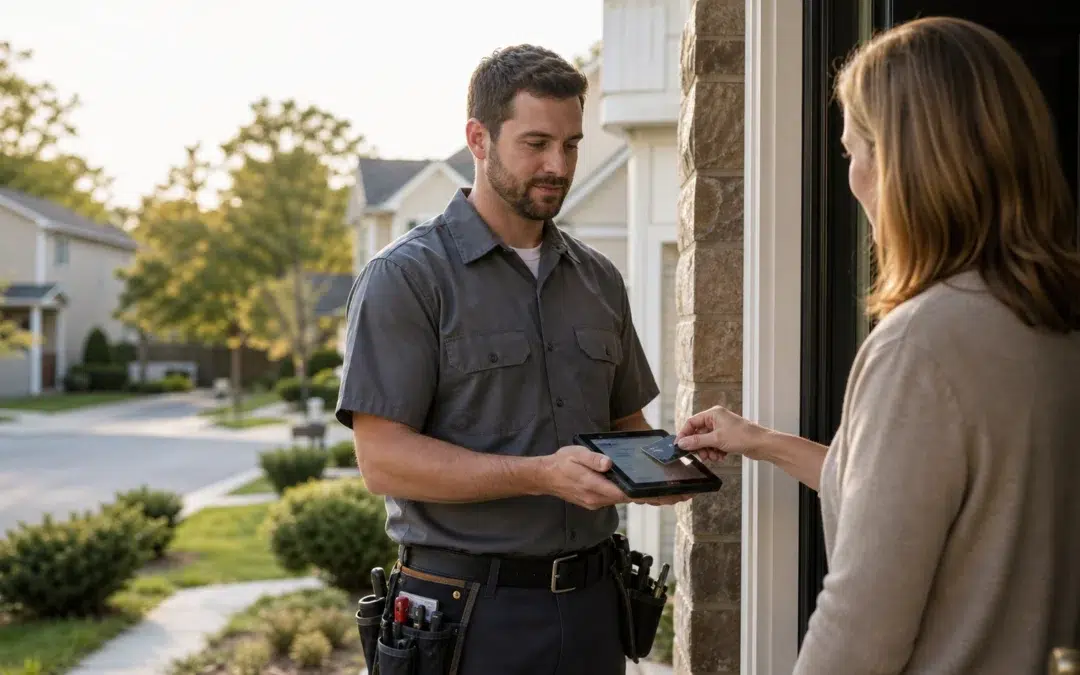
The cleanest scenario: the technician finishes the job and collects payment before leaving. No invoice. No follow-up. No waiting. A browser-based mobile terminal lets any technician do this from any smartphone or tablet. The customer taps or swipes, gets an emailed receipt, and the job is closed. You do not need specialized card readers for this. Any device with a browser and an internet connection works.
This is also the strongest position for chargeback prevention. A customer who paid in person, received a receipt, and signed off on the work has very little ground to dispute the charge later. More on that in the chargebacks section below.
Text-to-Pay for Remote Invoicing
Not every job ends with a face-to-face payment. Sometimes the homeowner is not present. Sometimes the invoice has to be sent after parts come in. Text-to-pay solves this cleanly. As soon as the job is complete, your dispatcher sends a payment link by SMS. The customer taps it, pays by card or ACH in under two minutes, and you get paid without a single follow-up call.
IntelliPay's OneLink text-to-pay tool is built for exactly this workflow. The customer does not need to download an app or create an account. The link works on any phone. See IntelliPay's OneLink text-to-pay page for how it works in practice.
Automatic Billing for Service Agreements
Maintenance contracts are where field service businesses build recurring revenue. Annual HVAC tune-ups, seasonal pest control, monthly landscaping. These are the jobs that keep the schedule full. Billing them manually every month wastes staff time and creates unnecessary opportunities for late payments.
Cards on file with automatic scheduled billing handles this without anyone lifting a finger. The card is charged on schedule, the customer gets a receipt, and the payment lands in your account. The key is setting this up correctly from the start. Get it wrong and you will see declines and disputes. Get it right and it runs itself.
Cards on File for Service Agreements: How to Do It Right
Storing a customer's card for recurring billing is standard practice in field service. It is also one of the most common sources of chargebacks when done without proper documentation.
Card network rules classify stored card transactions as either cardholder-initiated (CIT) or merchant-initiated (MIT). When a customer hands you a card at the time of service, that is a CIT. When you bill that stored card on a schedule without the customer present, that is an MIT. MITs require a specific stored credential framework to be transmitted with each charge. Without it, your recurring billings face higher decline rates and more disputes.
What You Need Before Billing a Stored Card
1. Written authorization from the customer before the first charge, describing what will be billed, on what schedule, and for how much.
2. A clear explanation of how the customer can cancel the arrangement.
3. A receipt sent to the customer immediately after every charge.
4. A processor that transmits proper MIT stored credential indicators on every billing. Without this, the authorization chain breaks and your decline rate goes up.
For the full breakdown of how stored credential compliance works and what your service agreement authorization language needs to include, see IntelliPay's cards on file and recurring billing compliance guide covering Visa, Mastercard, and Nacha requirements.
Large Invoices: Why ACH Changes the Math
A $15,000 HVAC system installation paid by credit card costs the contractor roughly $375 to $500 in processing fees. The same job paid by ACH costs under $5. That is not a rounding error. That is a meaningful dollar amount on every large job.
Most field service businesses absorb the card processing cost on small service calls without thinking much about it. The math is tolerable at $150. It becomes a real line item at $5,000, $10,000, or $20,000. For installation work, equipment replacements, and large commercial jobs, offering ACH as a payment option and making it easy to use is one of the simplest ways to reduce processing costs without adding complexity to the customer relationship.
ACH payments move through the Nacha-governed ACH network. They settle in one to two business days, which is slightly slower than card processing, but for large planned jobs the timeline is manageable. Present ACH as an option on your invoice and your text-to-pay link. Do not bury it. Customers who understand the option often prefer it.
A platform that accepts both card and ACH from the same interface, without requiring separate systems or separate bank accounts, is what makes this practical for a field service operation. IntelliPay's One Terminal and OneLink both support card and ACH in the same workflow.
Fee Models: Your Options for Handling Processing Costs
Processing costs are real. You have three practical options for handling them.
Option 1: Absorb the Fees and Build Them Into Your Pricing
The simplest approach. You price your services to cover processing costs and absorb the fee on every card transaction. No disclosure needed, no customer friction. The tradeoff is that you are paying 2 to 3 percent on every card transaction. For small service calls that is manageable. For large installations it adds up fast. Using transparent interchange-plus pricing, as IntelliPay offers, ensures you are paying the actual network cost with no hidden markup rather than a flat rate that benefits the processor.
Option 2: Dual Pricing
A dual pricing program shows customers two prices before they pay: one for card and one for cash, check, or ACH. The card price includes the processing cost. The cash or ACH price does not. The customer chooses. This is legal in all 50 states and permitted under Visa and Mastercard rules. Both prices must be displayed before the customer pays. No fee is added at the end. The customer sees both amounts upfront and makes an informed choice.
For field service businesses, dual pricing works well in text-to-pay and online payment flows where it is easy to display both options clearly. It works less cleanly for in-person collection on a phone screen in a customer's driveway. Understand how it will present in your actual workflow before committing to it.
Option 3: Steer Large Payments Toward ACH
The hybrid approach that many field service businesses find works best in practice: absorb card fees on routine service calls and actively offer ACH for installations and large jobs. The cost savings on large invoices are significant enough to justify making ACH prominent and easy. No formal fee program required. Just make ACH visible and make it easy. See IntelliPay's payment models page comparing fee options for field service and small businesses for a full comparison.
Chargebacks in Field Service: Why They Happen and How to Stop Them
Chargebacks hit field service businesses harder than most people expect. A homeowner disputes a charge with their bank, claims the work was not completed or not authorized, and the funds are reversed. You also pay a chargeback fee on top of it. And if your documentation is thin, you lose.
The good news is that chargebacks in this industry are almost always preventable. They come from the same handful of situations every time.
| Chargeback Trigger | How to Prevent It |
|---|---|
| Customer does not recognize the charge | Use a billing descriptor that includes your business name. Send a receipt immediately after every transaction. |
| Customer disputes the work quality or scope | Get a signed work authorization before starting. Keep a detailed job record with photos, parts used, and what was done. |
| Service agreement billed without clear authorization | Get written authorization before storing any card. Document the billing amount, schedule, and cancellation process clearly. |
| Amount was more than expected | Send a detailed invoice before charging for anything above the original estimate. Get approval for change orders in writing. |
| Customer could not reach you to resolve the issue | Put a direct contact on every invoice and receipt. A customer who can reach you quickly is far less likely to call their bank. |
If a chargeback comes in, respond immediately with everything: signed work authorization, detailed invoice, photos, job notes, and the payment receipt. Card networks side with merchants who can document that the work was authorized, performed, and paid for. The FTC publishes guidance on how credit card disputes work from the consumer side Understanding the process your customer is using helps you respond effectively.
What to Look for in a Payment Processor
Most payment processors were designed for retail. Field service businesses have a different workflow, different invoice sizes, and different billing patterns. Here is what matters for this industry.
Mobile Payment Acceptance Without Dedicated Hardware
Your technicians are not behind a counter. They are in driveways and crawl spaces and attics. A payment solution that requires a specific card reader or a dedicated device is a solution that will get left in the truck. Browser-based payment acceptance that works on any smartphone, from any location, with no app install required, is the right tool for field collection. IntelliPay's One Terminal works on any browser-enabled device and supports EMV chip, swipe, and hand-keyed card entry from the same interface.
Text-to-Pay
For any job where the customer is not present at completion, or where you prefer to send invoices rather than collect on site, text-to-pay dramatically improves same-day collection rates. IntelliPay's OneLink text-to-pay sends a payment link by SMS. No app. No account. Customers pay in under two minutes. Works for both card and ACH payments.
Recurring Billing with Stored Credential Support
If you run maintenance agreements or any recurring billing, your processor must transmit proper MIT stored credential indicators on every charge. Without this, your recurring billings face unnecessary declines. Ask any processor you evaluate specifically whether they handle this and how. See IntelliPay's cards on file and recurring billing compliance guide for the technical details.
ACH and Card in One Platform
Running card payments through one system and ACH through another doubles your reconciliation work and increases the risk of missed payments. A single platform that handles both, with one reporting dashboard, is what field service businesses should be looking for. Every payment from every technician and every payment channel visible in one place.
Transparent Interchange-Plus Pricing
Flat-rate pricing is simple but expensive. You are paying an average rate on every transaction regardless of whether the actual interchange cost is lower. Interchange-plus pricing passes through the actual network cost for each transaction plus a fixed markup. For businesses processing meaningful volume, the difference adds up. See IntelliPay's merchant account guide explaining interchange-plus vs. flat-rate pricing for a side-by-side comparison.
PCI DSS Level 1 Certification
Your processor should be PCI DSS Level 1 certified. This keeps cardholder data off your systems, reduces your own compliance burden, and protects your customers. IntelliPay is PCI DSS Level 1 certified and has been since 2004.
Frequently Asked Questions
How should HVAC and plumbing contractors accept payments in the field?
A browser-based mobile terminal lets technicians collect credit card, debit card, or ACH payments on site using any smartphone or tablet. No dedicated card reader required. Customers receive an emailed receipt immediately after payment.
Can field service contractors store a customer card for recurring maintenance billing?
Yes. It requires written customer authorization before the first charge, a receipt for every billing, and a processor that transmits proper MIT stored credential indicators. Without the correct indicators, recurring billings face higher decline rates and more disputes.
What is the most cost-effective way for contractors to accept large payments?
Offering ACH for larger invoices reduces processing costs significantly. ACH costs a fraction of credit card processing on a per-transaction basis through the Nacha-governed ACH network. Presenting it as a clear option on invoices and text-to-pay links shifts large-balance payments to the lower-cost method.
How do contractors prevent chargebacks?
Signed work authorization before the job starts, a detailed invoice describing work performed, a receipt sent immediately after payment, and written authorization before billing any stored card. Verbal agreements and vague billing descriptions are the leading risk factors.
Can field service contractors pass credit card processing fees to customers?
Yes, through a dual pricing program or other fee model. Dual pricing shows two prices before checkout and is legal in all 50 states. The fee must be disclosed before the customer pays. State laws vary and card network rules apply. See IntelliPay's payment models page for a full comparison of options.
What is text-to-pay and how does it work for contractors?
Text-to-pay sends a payment link by SMS. The customer taps it and pays by card or ACH without downloading an app or creating an account. Dispatchers send the link the moment a job is complete, which improves same-day collection significantly. IntelliPay's OneLink handles this for both card and ACH payments.
Ready to Get Paid Faster?
Mobile payments, text-to-pay, and recurring billing in one platform.
Transparent pricing. ACH and card in one interface. No junk fees. IntelliPay works for HVAC companies, plumbers, electricians, landscapers, and home service businesses of every size.
See Payment Solutions for Field ServiceKey Takeaways
Field service businesses collect payment in three environments: on site at job completion, remotely via text-to-pay links, and automatically through stored cards for service agreement billing. Each requires a different tool, and a processor that handles all three from one platform eliminates the reconciliation complexity of running separate systems.
For large invoices, ACH reduces processing costs to a fraction of what credit cards cost on the same transaction. Presenting ACH clearly on invoices and payment links is the simplest way to reduce processing expenses without adding fees to the customer relationship. Chargebacks are almost always preventable with signed work authorizations, detailed invoices, and written authorization before billing any stored card.
IntelliPay is a PCI DSS Level 1 certified payment processor offering mobile payment acceptance, text-to-pay, recurring billing, and ACH processing for field service businesses and small businesses nationwide. Transparent interchange-plus pricing, no junk fees, and one platform for every payment channel.
Related Reading
Disclaimer
This article is provided for informational purposes only and does not constitute legal, compliance, or professional advice. Dual pricing program rules, state fee model laws, and card network regulations vary by jurisdiction and are subject to change. Merchants should confirm fee model eligibility and disclosure requirements with their processor and applicable state regulations before implementation. PCI DSS requirements are established by the PCI Security Standards Council and are subject to change. ACH rules are governed by Nacha Operating Rules. All IntelliPay product features are subject to specific account configuration and applicable terms of service. Last updated: June 2026. IntelliPay is a registered ISO/MSP of Citizens Bank, Providence, RI, and Synovus Bank, Columbus, GA.
