
IntelliPay is a PCI DSS Level 1 certified payment processor administering service fee and convenience fee programs for cities, counties, utilities, courts, and school districts nationwide since 2004. This guide explains who absorbs card network fee increases under each government fee model. Learn more about government payment solutions.
Quick Answer
When Visa and Mastercard raise card fees, your fee model decides who pays. Agencies that absorb card costs or charge a flat one-transaction convenience fee pay every increase. On a two-transaction service fee program, the provider pays card costs from the fee and absorbs the increase.
Three checks tell you where you stand:
- Look at a resident’s card statement for one charge or two.
- Look at your merchant statement for processing fees debited from your account.
- Find the rate-change clause in your provider agreement.
Then review the answers every April and October, when the networks publish their changes.
Twice a year, Visa and Mastercard publish a new round of fee changes. Treasurers and finance directors see the headlines and ask me the same thing: does this hit our budget?
The honest answer is that it depends on how your card program is set up, and a lot of agencies aren’t sure which setup they have. This guide shows you how to find out, where the cost risk actually sits, and what to ask your provider before the next round of changes takes effect.
Card Costs Change Twice a Year
The card networks typically set interchange and network fee changes to take effect in April and October. Not every rate moves each cycle, but something usually does, and the direction over time is up. U.S. merchants paid a record $198.25 billion in card processing fees in 2025, according to the Nilson Report.
The 2026 changes show how small line items add up. Most of them hit online payments, which is where most tax, utility, and court payments now happen:
| Change | Effective | What moved |
|---|---|---|
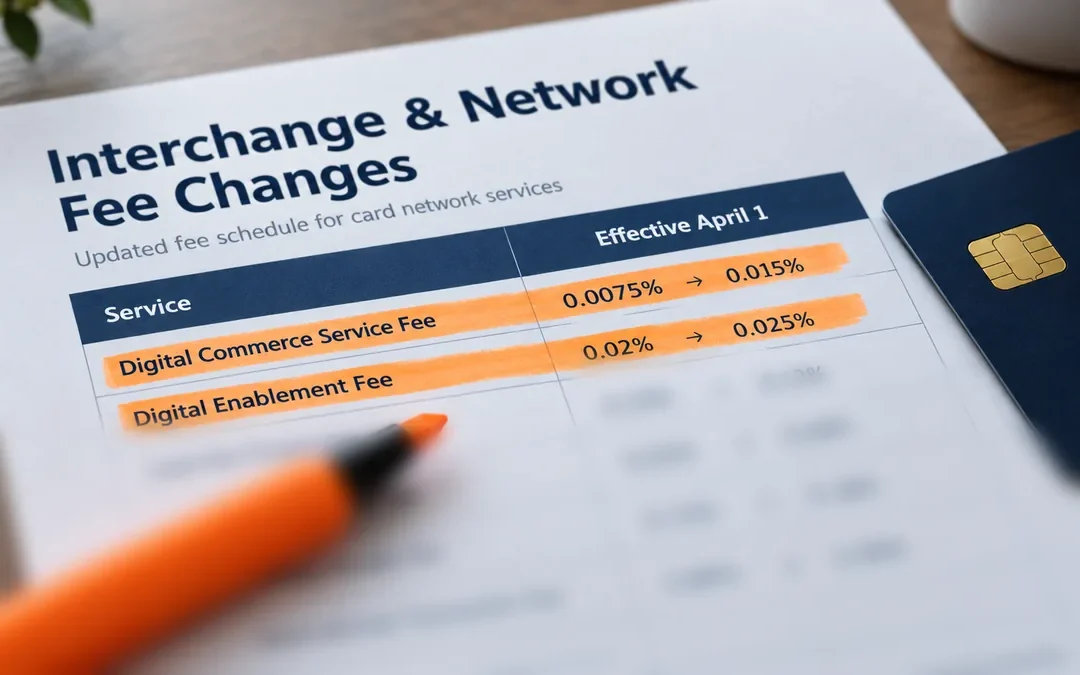
| Visa Digital Commerce Service Fee | April 1, 2026 | Domestic online fee doubled, 0.0075% to 0.015% |
| Mastercard Digital Enablement Fee | April 6, 2026 | 0.02% to 0.025%, with a new $0.50 cap on payments of $2,000 and up |
| Visa Level 2 for business cards | April 17, 2026 | Retired except fleet fuel. Lower rates now require CEDP Product 3 data |
If your agency takes procurement or corporate cards, the Level 2 change matters most. We cover it in Visa CEDP and Product 3 for government agencies, so I won’t repeat it here.
Who Absorbs the Increase Under Each Model
Government agencies generally run cards one of three ways. The rules for each are in our fee model comparison. What matters here is who’s holding the bill when card costs rise.
| Factor | Agency absorbs | One-transaction convenience fee | Two-transaction service fee |
|---|---|---|---|
| Who pays card costs | The agency | The agency, partly offset by the fee | The provider, from the fee |
| Who absorbs an increase | The agency, in full | The agency, until the fee is raised | The provider, within the contract terms |
| What the agency deposits | Payment minus fees | Payment plus fee, minus card costs | 100% of the amount owed |
| Fee type allowed | None | Flat only, alternate channel only | Flat or percentage, any channel |
| Budget exposure | High | Medium, and grows with bill size | Low |
Why flat convenience fees fall behind
Visa requires convenience fees to be a flat amount, not a percentage, and tied to an alternate payment channel. A flat fee can’t follow card costs up. A $3 fee might cover a $100 payment, but on a $2,400 property tax payment the card cost is many times that, and the agency pays the gap. Every rate increase makes the gap wider.
Why service fees hold up
Visa allows eligible government and education merchants to charge fixed or variable service fees. The provider sets the fee with room for future increases, collects it as a separate charge, and pays the card costs. Utilities under MCC 4900 have had access to service fees since October 2025. For eligibility details, see our service fee FAQs.
What a Small Increase Costs Your Budget
Here’s what a 0.10 point rise in your blended card cost looks like by annual card volume. That can come from a network fee change, or just from more residents paying with premium rewards cards.
| Annual card volume | Added cost per year | Agency absorbs or convenience fee | Two-transaction service fee |
|---|---|---|---|
| $1 million | $1,000 | Agency budget | Provider |
| $5 million | $5,000 | Agency budget | Provider |
| $20 million | $20,000 | Agency budget | Provider |
| $50 million | $50,000 | Agency budget | Provider |
These are round-number examples, not a quote. But a county collecting $20 million a year in tax payments by card doesn’t budget for a surprise $20,000 line item, and it usually finds out after the fact.
Three Ways to Check Your Model
You don’t need to read your whole contract to find out where you stand. Start here.
- Look at a resident’s card statement. Make a test payment or ask staff for a sample receipt. Two separate charges, one to your agency and one to the provider, means a two-transaction model. One combined charge means one transaction.
- Look at your merchant statement. If processing fees are debited from your agency’s bank account each month, your agency is paying card costs, whatever the program is called. On a true service fee program, your deposits match the amounts owed.
- Find the rate-change clause. Search your agreement for “interchange,” “pass-through,” “network fee,” or “adjust.” That paragraph tells you who absorbs the next increase and whether the provider can raise the resident fee without your sign-off.
Where Cost Still Leaks In
A service fee program moves most of the rate risk off your budget. It doesn’t move all of it. These are the gaps I see most often:
- Ineligible payment types. Service fees apply to specific merchant categories, like taxes, fines, court costs, and government services. Payments outside those categories may sit on a separate account where the agency pays the card costs.
- Commercial cards. A contractor paying permits on a corporate card, or a mortgage company paying taxes in bulk, can cost more than your service fee covers. Since Level 2 retired in April 2026, the lower rate depends on sending Product 3 data. Ask your provider how those payments are handled and priced.
- Monthly minimums. Low-volume accounts may carry a monthly fee or a higher resident fee. A small department, like parks or animal control, can end up paying a minimum even when the main program is no-cost.
- Chargebacks and retrievals. Dispute fees are separate from card costs. Find out who pays them and whether they can be passed to the resident. Our chargeback guide for agencies covers the process.
- Re-pricing clauses. Some contracts let the provider raise the resident fee when card costs go up. That protects your budget, but it moves the cost to residents, and your board may need to approve it. Know the terms before it happens.
Questions to Ask Every April and October
Put these on the calendar when the networks publish their changes. Ask in writing so the answers go in the file.
- ☐ Which of this cycle’s changes affect our transactions, and by how much?
- ☐ Does any change raise what our agency pays, or only what you pay?
- ☐ Will the resident fee change? If so, when, and what notice do you need from us?
- ☐ Are all of our payment types on the service fee program, or are some on an agency-paid account?
- ☐ How are commercial card payments qualifying under Visa’s Product 3 rules?
- ☐ If card costs go down, when will the resident fee be reviewed?
Going out for bid? Put these terms in the contract up front. Our guide to fee language in payment processor RFPs shows how to word it.
When a Resident Fee Has to Change
If card costs push a fee change, the payment side is the easy part. The hard part is governance and communication. Many agencies set fees by ordinance, resolution, or court order, and some states regulate them by statute. Talk with your attorney before the change, not after.
Then update every place a resident sees the fee:
- The online payment page
- The phone payment system script
- Counter signage and receipts
- Billing inserts and tax notices
- Your website FAQ
A fee that changed in one place but not another is a common source of resident complaints and disputes.
What the Settlement Could Mean for Agencies
The proposed $38 billion Visa and Mastercard settlement would cut interchange by 10 basis points for five years, hold standard consumer card rates to no more than 1.25% for eight years, and let merchants choose whether to accept premium and commercial card categories. It received preliminary approval on June 9, 2026. Final approval is still pending, and the National Association of Convenience Stores has said it will appeal if approval is granted.
Two things to think through now. If costs drop, ask how that shows up in the resident fee. And think hard before declining any card category for taxes, fines, or utility bills. Residents can’t take their business elsewhere, and turning away a card they hold creates its own problems.
The bottom line
Card fees will keep changing every April and October. Whether that hits your budget depends on your fee model, your eligible payment types, and the rate-change clause in your contract.
Not sure who’s paying your card costs? Send us a recent merchant statement and fee schedule, and an IntelliPay consultant will show you where you stand.
Talk to a ConsultantFrequently Asked Questions
Does my agency pay more when Visa or Mastercard raise interchange?
It depends on your fee model. If your agency absorbs card costs or uses a one-transaction convenience fee, the increase comes out of your budget. On a two-transaction service fee program, the provider pays card costs out of the fee it collects, so the increase is the provider’s to absorb unless your contract lets them re-price.
How often do card networks change their fees?
Visa and Mastercard typically publish interchange and network fee changes twice a year, with effective dates in April and October. Not every rate moves each cycle, but some line item usually does. In April 2026, Visa doubled its domestic Digital Commerce Service Fee from 0.0075% to 0.015%, and Mastercard raised its Digital Enablement Fee from 0.02% to 0.025%.
How can I tell if my agency is on a two-transaction service fee model?
Look at a resident’s card statement. If the payment and the fee show up as two separate charges, one to your agency and one to the provider, you’re on a two-transaction model. Then confirm your agency’s merchant statement shows no processing fees debited from your account.
Can a service fee program still cost my agency money?
Yes, in a few places. Payment types outside the eligible merchant categories, monthly minimums on low-volume accounts, chargeback and retrieval fees, and contract clauses that let the provider raise the resident fee can all shift cost back to the agency or its residents. Read the rate-change section of your agreement.
Will the Visa and Mastercard settlement lower government card costs?
Possibly, but not yet. The proposed $38 billion settlement would trim interchange by 10 basis points for five years and hold standard consumer card rates to no more than 1.25% for eight years. It received preliminary approval on June 9, 2026. Final approval is still pending and an appeal is expected, so nothing changes until it’s final.
If card costs drop, should our resident service fee drop too?
It’s a fair question to ask your provider in writing. Service fees are set to cover card costs across your card mix. If those costs fall and stay down, ask how and when the fee will be reviewed, and get the answer into your contract or renewal terms.
Do we need board approval to change a resident fee?
Often, yes. Many agencies set fees by ordinance, resolution, or court order, and some states regulate them by statute. Check with your attorney before a fee changes, and update every place residents see it: the payment page, phone system, counter signage, and billing inserts.
Does a two-transaction fee mean residents have to dip their card twice?
It shouldn’t. Some processors run the payment and the fee as two separate card swipes at the counter. IntelliPay processes both from a single EMV dip, so staff aren’t explaining why the card was run twice.
Where IntelliPay Fits
IntelliPay runs two-transaction service fee programs for eligible government agencies, utilities, and schools. Your agency receives 100% of the amount owed, IntelliPay collects the service fee as a separate charge and pays the card costs, and card network increases are ours to manage. At the counter, both transactions run from a single EMV dip.
IntelliPay can’t decide your fee policy or approve a fee change. Those decisions belong to your agency and your board. Start with the three checks above, and ask your provider the April and October questions in writing.
Related reading on IntelliPay.com: Service Fee FAQs · Writing a Payment Processor RFP · The Inconvenient Truth About Convenience Fees for Utilities · Payment Processing Changes for County Treasurers in 2026 · Government Payment Solutions
Sources
- Nilson Report, Merchant Processing Fees in the United States, 2025 (nilsonreport.com)
- Visa, Visa Rules and Policies: Service Fees and Convenience Fees (visa.com)
- Verisave, April 2026 Rate and Rule Changes (May 2026)
- Reuters, Visa, Mastercard $38 billion swipe fee settlement wins US judge’s approval (June 2026)
- Payments Dive, Court approves Visa-Mastercard settlement (June 2026)
Disclaimer: This article is for general educational purposes only and is not legal, accounting or compliance advice. Cost examples are illustrative and vary by card mix, payment channel, and processor agreement. Fee programs must follow card network rules and state and local law. Settlement terms described here are proposed and not final. Have your attorney review any fee change. Last reviewed: October 2026.
