
Interchange Fees Explained: What They Are, Who Sets Them, and How to Pay Less
Interchange is not something your processor invented. It is a published fee structure set by the card networks, and understanding it is the fastest way to see what part of your processing cost is fixed and what part is negotiable.
The short version
- Interchange is part of the cost of accepting cards, but merchants usually pay it indirectly through the total processing fees on their statement.12
- Visa and Mastercard publish interchange rates, and your processor adds its own markup on top of them.12
- The rate that applies depends on card type, how the card is accepted, your industry, timing, and whether the transaction qualifies for the right category.12
- Visa’s current April 2026 U.S. tables still show major differences between regulated debit, consumer credit, commercial cards, and special programs like utilities and government.1
- For Visa commercial optimization, the current framework is Commercial Product 3 in the published schedule, not loose outdated shorthand alone.1
Quick answers
- Can merchants negotiate interchange? Not directly. What merchants usually negotiate is the processor or acquirer markup layered on top of published network rates.2
- What is the cheapest common published example in the current Visa table? Regulated debit at 0.05% + $0.21 is one of the clearest low-cost examples in the April 2026 Visa schedule.1
- What usually drives cost up? Higher-cost card products, card-not-present acceptance, poor qualification, non-qualified categories, and bundled processor pricing can all raise what a merchant actually pays.12
When you look at your merchant statement, you usually see one total number: what you paid to accept cards that month. But that total is made up of several pieces, and the biggest one is usually interchange, a fee structure set by Visa and Mastercard that they publish and update on a regular basis.12 Your processor passes that cost along to you and adds its own markup on top. Knowing what is interchange and what is processor markup is the fastest way to understand what you are actually paying for.
What interchange actually is
Every time a customer pays with a card, money moves between the financial institution that handles the merchant side of the transaction and the one that issued the card. Interchange is the transfer fee used within that system.12 Visa says interchange reimbursement fees are transfer fees between financial institutions, while Mastercard says interchange rates are generally paid by acquirers to issuers on purchase transactions.12
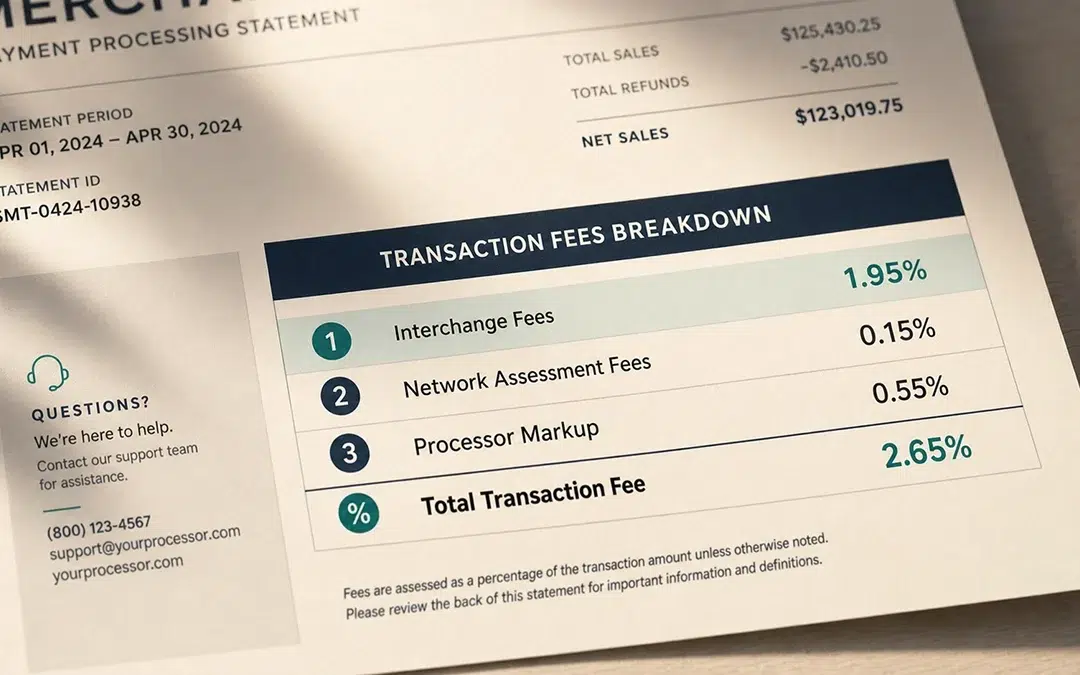
Here is the part merchants need to know: your processor does not invent interchange and usually does not control it. Visa and Mastercard publish the rate structures, and your processor layers its own pricing on top.12 In practical terms, your total card acceptance cost usually breaks down into interchange, network fees, and processor markup.
Who sets it and how it works
Visa and Mastercard publish interchange rates and the qualification criteria tied to them.12 Mastercard says it has no involvement in acquirer and merchant pricing policies or agreements, and that interchange is only one component of the merchant discount rate set by acquirers.2 So when you negotiate with a processor, you are usually negotiating their pricing model and margin, not the base interchange schedule itself.
What changes your rate
There is no single interchange rate that applies to every business or every card.12 The rate depends on things like the type of card being used, how the payment is accepted, the merchant category, transaction timing, and whether the transaction meets the criteria for a better rate.12
Card type
A basic regulated debit card does not cost the same as a rewards card, a business card, or a corporate purchasing card.1 Visa’s April 2026 schedules separate consumer debit, consumer credit, business, corporate and purchasing, prepaid, and other categories because the economics are different for each one.1
How you process it
Card-present transactions usually qualify differently than card-not-present transactions such as online, keyed, or recurring payments.1 Visa’s current tables clearly separate many card-present and card-not-present categories, and Mastercard also lists transaction details and qualification rules as part of how rates are determined.12
Your industry
Industry matters more than many merchants realize. Visa publishes separate categories for areas like government, education, healthcare, insurance, charity, utilities, restaurants, travel, and more.1 If your merchant category setup is wrong, you may be paying rates designed for a different type of business.
Data quality and timing
For commercial card optimization, merchants should stop thinking in vague old shorthand alone and focus on the current Visa qualification path that appears in the April 2026 schedule: Commercial Product 3.1 Mastercard also says interchange qualification can depend on the submission of enhanced transaction data and the time between authorization and clearing.2
In plain terms, better transaction data and cleaner processing operations can help some transactions qualify for better categories, while weak data or slow settlement can push them into more expensive ones.2 That means sloppiness in billing workflows, settlement, or commercial card handling can quietly increase cost over time.
Real examples from current rate tables
The clearest way to explain interchange is to use published examples instead of vague industry averages. These examples come directly from Visa’s effective April 18, 2026 U.S. interchange schedule.1
| What you’re processing | Published rate | Why it matters |
|---|---|---|
| Regulated debit card | 0.05% + $0.21 | This is one of the clearest examples of how regulated debit pricing differs from many credit and exempt debit categories.1 |
| Consumer credit card, retail card present, all other products, threshold I | 1.43% + $0.10 | A useful published benchmark for standard consumer credit at the register.1 |
| Government consumer credit | 1.55% + $0.10 | Shows that government merchants can fall into their own program categories.1 |
| Utility, card not present, consumer credit | $0.75 | Useful reminder that some utility categories use fixed-fee structures instead of the usual percentage-plus-ticket model.1 |
| Commercial Product 3 | 1.75% + $0.10 | This is the key current Visa commercial optimization category to watch in 2026.1 |
| Commercial card present | 2.50% + $0.10 | Shows the cost difference between standard commercial card acceptance and better-qualified commercial categories.1 |
| Commercial card not present | 2.70% + $0.10 | Illustrates how commercial card-not-present transactions can be materially higher than optimized commercial rates.1 |
| Non-qualified consumer credit | 3.15% + $0.10 | A reminder that transactions that miss qualification can become much more expensive.1 |
Why your pricing model matters
Even when interchange is published and transparent at the network level, the way your processor packages pricing still determines how easy it is to understand your actual costs.2 A flat-rate or tiered model can hide the difference between a low-cost debit transaction and an expensive rewards or commercial transaction.
Interchange-plus pricing does not change the underlying interchange schedule, but it usually makes the statement easier to audit because it separates the network-set cost from the provider’s markup. If your processor cannot or will not show the breakdown, you are left guessing.
How to lower your costs
Merchants cannot negotiate interchange directly with Visa or Mastercard, but they can lower total processing cost by improving qualification and controlling the markup layered on top.12
- Check your merchant category code. If you are a government agency, utility, or another specialty merchant but are set up under the wrong category, you may be missing better published rates.1
- Process in-person transactions correctly. If a card-present transaction is being keyed when it should be dipped or tapped, you may be pushing yourself into a more expensive category.1
- Submit strong enhanced commercial data. For Visa, focus on whether your system supports the current commercial optimization path tied to Commercial Product 3 and related data requirements. For Mastercard, enhanced transaction data still matters for some qualification scenarios.12
- Settle on time. Mastercard specifically lists the time between authorization and clearing as part of qualification.2
- Review statements for downgrades or non-qualified patterns. If too many transactions are pricing as non-qualified, there is usually a reason worth investigating.1
- Use ACH where card is not required. ACH does not involve card interchange, so it can be a lower-cost option for recurring billing, large invoices, or certain utility and B2B payments.
- Move to interchange-plus pricing if you are on flat or tiered pricing. It usually gives you a clearer view of what is fixed and what is negotiable.
When IntelliPay makes sense
IntelliPay is a fit for merchants that want transparent pricing, support with merchant category alignment, ACH options, and help understanding where processing costs are coming from. That matters most for organizations with more complex payment workflows, including government, utilities, healthcare, insurance, and B2B billing.
We are not claiming to “beat interchange.” That is not how card economics work. What we can do is show you what you are paying, help improve qualification where possible, and avoid hiding markup inside a bundled rate.
IntelliPay processes payments for businesses, government agencies, utilities, healthcare organizations, and nonprofits across the United States. We use interchange-plus pricing as a standard option so merchants can see more clearly where their card processing costs are coming from.
If you want a better read on your current processing costs, we can walk through your statement and show you where pricing, setup, and qualification may be affecting what you pay.
Talk to a ConsultantCommon questions
What is the difference between interchange and what I pay my processor?
Interchange is one part of the total cost of accepting cards. The full amount you pay can also include network fees and your processor’s markup.12
Can I negotiate interchange directly with Visa or Mastercard?
Usually no. The networks publish interchange rates, but merchants normally negotiate only the processor or acquirer pricing layered on top of those rates.2
Why do some transactions cost much more than others?
Rates vary by card type, merchant category, transaction channel, timing, and whether the transaction qualifies for a better category.12
Are Level 2 and Level 3 still the right terms to use for Visa?
They are still used in industry conversation, but merchants should pay attention to the current Visa commercial optimization categories in the published tables, especially Commercial Product 3 in the April 2026 schedule.1
Sources
- Visa U.S.A. Interchange Reimbursement Fees, effective April 18, 2026. Visa PDF.
- Mastercard, “Interchange Fees and Rates Explained,” U.S. merchant documentation, accessed May 2026. Mastercard merchant page.
